

On October 13, 2025, the Seminar on Intelligent Assessment in Higher Education and the Progress Meeting for the Key Projects of Philosophy and Social Sciences Research of the Ministry of Education (MOE) were convened in conference room 1182 of the Nanhu Building at our university.
The following individuals (listed in no particular order) were invited to attend this seminar: Wei Fan, Director of the Education Supervision Bureau of MOE; Jie Ma, Deputy Director of the same bureau; Zenglin Ren, Deputy Director of the China Academic Degrees and Graduate Education Development Center; Lieyun Ding, Academician of Chinese Academy of Engineering; Pingwen Zhang, President of Wuhan University; Lei Xu, former Vice President of Fudan University; Genshu Lu, Director of the West China Higher Education Evaluation Center at Xi’an Jiaotong University; Yunbo Yin, Director of the Hubei Provincial Center for Educational Informationization; as well as Shuangjie Peng, President of our university, and Sannyuya Liu, Vice President of our university, along with heads of relevant functional departments.
Project team members from Tsinghua University, Huazhong University of Science and Technology, Wuhan University of Technology, Xi’an University of Electronic Science and Technology, and other institutions also took part in the seminar.
The meeting was chaired by Zongkai Yang, former President of Wuhan University of Technology, Senior Professor of our university, and Chief Expert of the project.
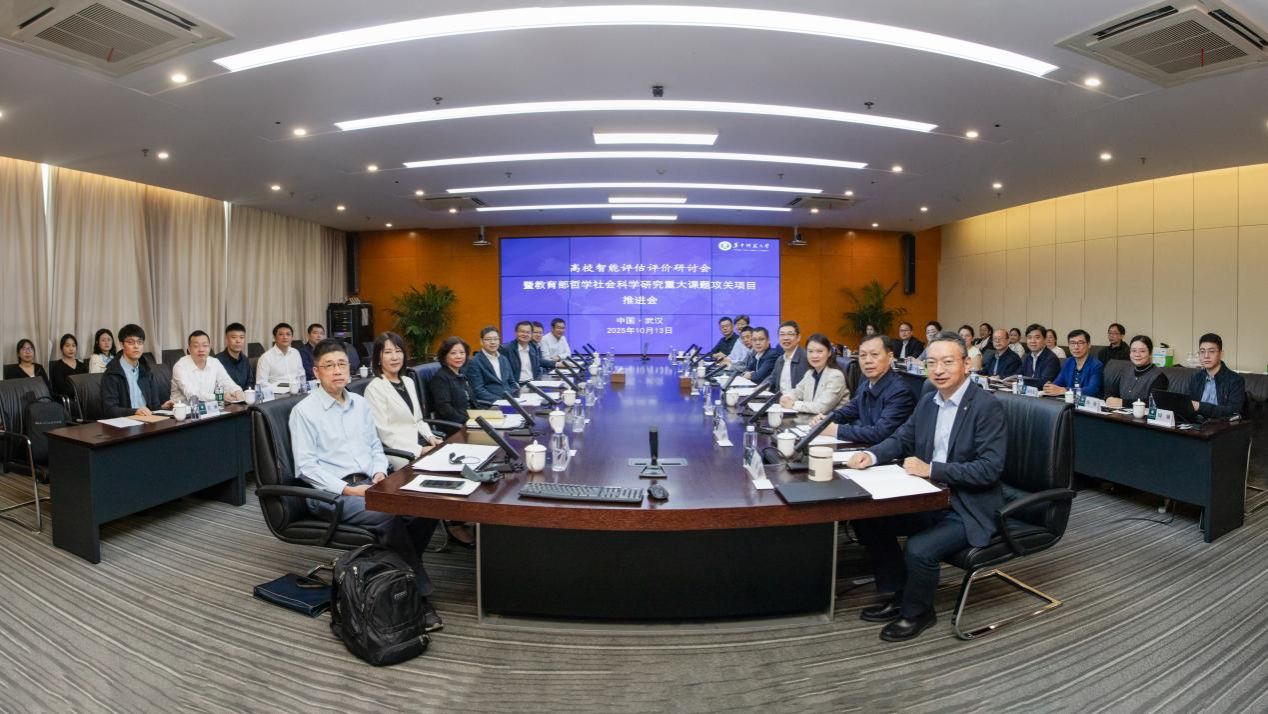
In his opening remarks, Sannyuya Liu stated that under the guidance of MOE, the university will continue to uphold the mission of “serving the national education cause and empowering the modernization of educational governance”. He emphasized the commitment to collaborate with other universities to explore digital-intelligent innovation paths for a higher education assessment system with Chinese characteristics. The university strives to contribute the “CCNU’s Approach” and “CCNU’s Wisdom” to the modernization of Chinese education.
Centering on the theme of intelligent assessment in higher education, the meeting delved into discussions on the phased achievements and practical explorations of the “Construction of an Intelligent Assessment Platform for Higher Education Institutions” project. It also advanced related work for a major project of Philosophy and Social Sciences Research of MOE “Innovative Research on Higher Education Teaching Assessment in the Digital-Intelligent Era”.
Professor Di Wu, Deputy Dean of the Faculty of Artificial Intelligence in Education, Executive Deputy Director of the National Engineering Research Center for E-Learning (NERCEL) and the National Engineering Research Center for Educational Big Data (NERC-EBD), along with his research team, provided a detailed report on the impressive progress of intelligent assessment research in higher education. They conducted a live demonstration of the application features and scenarios of the Higher Education Intelligent Assessment Platform.
As the Chief Expert of the project and Director of NERCEL and NERC-EBD, Professor Zongkai Yang offered further in-depth insights into the latest developments and phased outcomes of the research. He briefly analyzed existing challenges and outlined clear directions for subsequent efforts.
The participating experts highly commended the outcomes achieved by the project after hearing the research presentation. They engaged in in-depth discussions and exchanges on the concepts, pathways, and practices of empowering university evaluation with intelligent technology. It was unanimously agreed that this research project provides new ideas and directions for enhancing university governance systems and advancing the high-quality development of higher education.
In the concluding remarks, Wei Fan fully affirmed the progress made by the project team and clarified key tasks and working principles for future advancement. She expressed the deep hope that the research team would maintain its vitality in scientific innovation, further pool resources from multiple stakeholders based on expert feedback, solidly advance research efforts, complete tasks with high quality according to plan, and contribute even more to promoting innovative development in higher education teaching assessment in the digital-intelligent era.
During the seminar, conferees visited the exhibition hall of NERC-EBD on the 11th floor of the Nanhu Building. They gained a detailed picture of the center’s latest achievements in educational digital transformation, intelligent assessment, and technological innovation in educational big data.
Editor: Ruye LI
Reviewer: Xiaoxiao ZHU

 Home
Home phone
phone